Formation of the Brotherhood of the Condemned
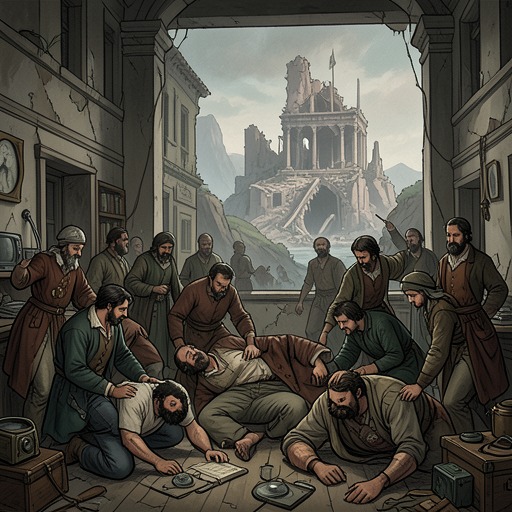
Last and First MenThe Formation of the Brotherhood of the Condemned is a collective act of resistance to spiritual collapse among the Last Men. Faced with a failing world and the knowledge that their own civilization is declining, its members bind themselves to one another and to the Scattering of the Seed, sustaining human dignity until their task is complete and death becomes permissible.
A World Governed by Sacred Duties
The Brotherhood arises against a long history in which social systems made religious obligation a means of organizing life. Among the First Men, science acquired extraordinary authority because it transformed material conditions; the scientist came to represent not only knowledge but power. Later, the First World State’s leaders sought a formal union of science and religion, reconciling rival creeds through their shared worship of divine energy. In another society, the worship of Gordelpus, the god of motion, made ceaseless activity a religious duty, while laws tightly controlled sexual knowledge and conduct. Such systems gave public and personal behavior a sacred rationale, but their duties belonged to established orders and authorities.
The history of the prophet offers a further contrast. His music-inspired faith spread among ordinary people, challenged aristocratic standards, and was met with government persecution; after the monarch adopted the movement, the prophet himself was confined and made an official oracle. Across these earlier examples, belief could inspire collective change, yet institutional power could also contain or redirect it. The Brotherhood’s purpose is narrower and more precarious: it does not claim to restore a world order, but to preserve a remnant of human spirit among people who know that their world is doomed.
Formation and Shared Vows
The Brotherhood is formed by those who have not yet sunk too far into the brutishness they see overtaking their society. They understand their effort as part of a larger undertaking that cannot be abandoned simply because it offers no rational promise of lasting success. Even if the human seed takes root elsewhere, its future remains subject to death; the members persist because the task was conceived in an earlier, more enlightened state and must be completed.
Their commitments define the group more clearly than any formal structure does. Members pledge faithfulness to one another, to their common undertaking, and to a vision that is no longer directly revealed to them. They undertake to comfort distressed people who are not yet permitted death, to assist in the dissemination of the seed, and to keep the human spirit bright for as long as they can. The Brotherhood is thus both a mutual-support fellowship and a religious community organized around an obligation its members continue to recognize even as their confidence in their former understanding has weakened.
Meetings and Mutual Consolation
The members meet in small groups and in larger companies to draw strength from one another’s presence. These gatherings do not guarantee consolation. At times the participants sit in silence, searching for comfort and strength; at others, spoken words pass among them, offering brief illumination without fully warming their spirits. The alternation matters: fellowship persists even when speech fails to resolve grief or restore the confidence of the past.
The youngest of the Last Men moves from group to group, and the members look to him for encouragement. His presence can help a sufferer smile at personal pain and can turn despair into a measure of peace. His role gives the Brotherhood’s meetings a human focus, but their shared work does not depend on him alone: the group has already pledged itself to mutual care, dissemination, and endurance.
Purpose and Significance
The Brotherhood does not claim that its work will defeat extinction. Its members know that the seed’s future may end in fire or in the advance of cold, and they can no longer recover the former sense that suffering belongs to a beautiful order. Their doubts distinguish this fellowship from the confident religious systems of earlier societies. They continue not because certainty has returned, but because their common duty remains binding despite despair.
In this final setting, the Scattering of the Seed becomes the last religious obligation of humanity, and the Brotherhood gives that obligation a social form. Its members preserve one another’s capacity for care while carrying out the task that outlasted their civilization. The event therefore marks neither a political restoration nor a reversal of the world’s decline; it marks a deliberate effort to keep human solidarity alive until the work is done.